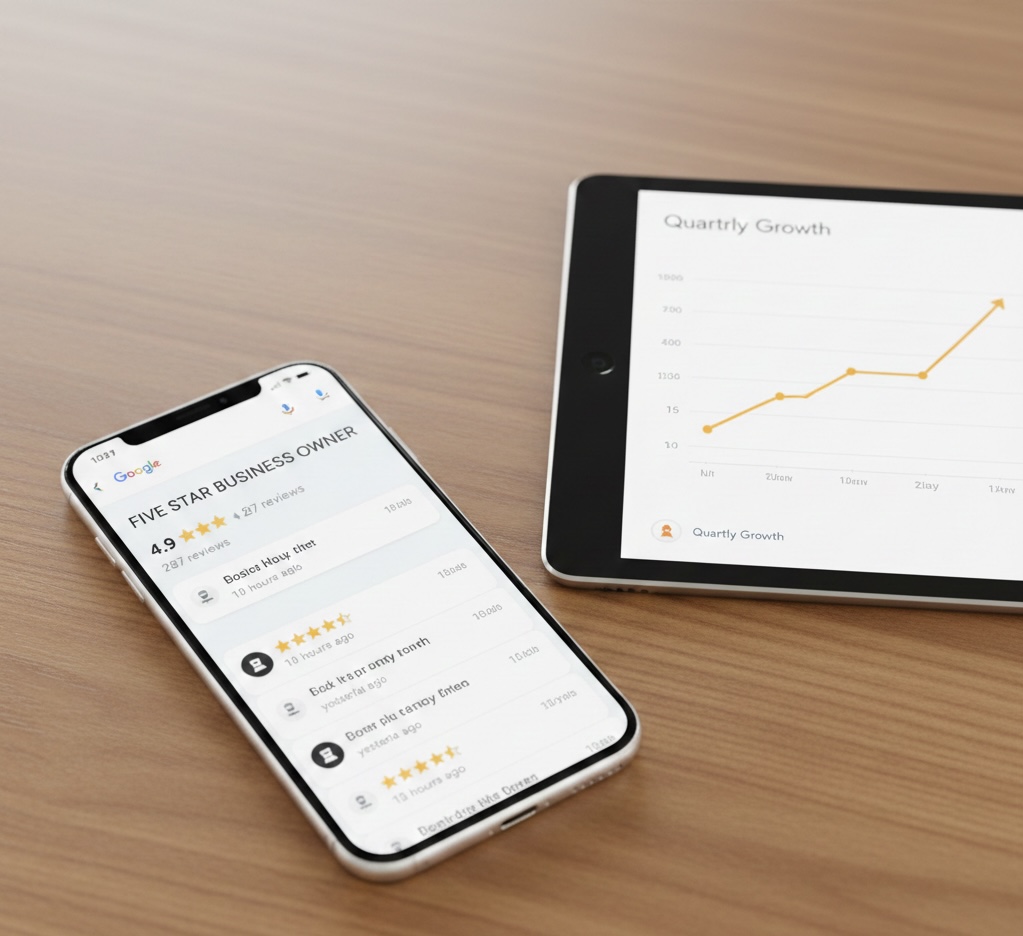
Why Customers Trust Some Businesses Before They've Ever Used Them
Walk into any competitive local market and you'll find the same baffling pattern.
One business has a packed schedule, a waitlist, and customers who defend them online like loyal fans. They're not the cheapest. They're not always the most experienced. They don't have the fanciest trucks or the biggest team.
But they have one thing every other business in their market is trying to figure out: customers trust them before the first conversation.
Not because they've earned it through years of relationship-building. Not because they have some magnetic personality. Because they've—intentionally or accidentally triggered the specific psychological mechanisms that create automatic trust in the human brain.
This guide breaks down the psychology operating beneath every 5-star business, the cognitive triggers that make prospects choose certain businesses before any other evaluation, and the systematic framework that engineers these psychological responses at scale. You'll stop guessing why some businesses win effortlessly and start building the same psychological infrastructure deliberately.
The Trust Paradox Every Business Owner Faces
Here's the fundamental problem with selling services:
Customers must trust you before they can experience your trustworthiness.
Unlike products where prospects can touch, examine, and evaluate before buying service businesses require a leap of faith. Prospects commit money, time, and often significant vulnerability (strangers in their home, access to their finances, their physical health) before experiencing any evidence of quality.
This creates a psychological vacuum. And nature including human psychology abhors a vacuum.
Into that vacuum rushes perception.
In the absence of direct quality evidence, the human brain fills the gap with proxy signals. Cognitive shortcuts. Heuristics that evolved to help us make fast decisions with incomplete information.
The businesses that understand this consciously or instinctively design their presence around triggering the right psychological responses. The businesses that don't understand this work harder and harder at service quality while losing deals to competitors who've accidentally or deliberately mastered the psychology of trust.
The cost of this psychology gap:
Conversion rates 40-60% lower than psychologically optimized competitors
Constant price pressure because trust hasn't pre-justified value
Longer sales cycles burning more labor per deal
Higher customer acquisition costs offsetting service quality advantages
Understanding the psychology isn't optional. It's the foundation of every growth decision you make.
The 7 Psychological Mechanisms Behind 5-Star Businesses
Mechanism 1: The Social Proof Cascade
The Psychology:
In 1951, Solomon Asch demonstrated that humans will override their own accurate judgment to conform with group consensus. We're wired to assume that what many people believe or do is correct and safe.
This isn't weakness. It's efficiency. When facing decisions with incomplete information, using others' collective experience is genuinely smart.
How It Operates in Your Market:
When a prospect sees 200 reviews, their brain processes this as 200 separate people making an independent decision that this business was good enough to review positively. The aggregate judgment of 200 strangers carries enormous psychological weight.
But the cascade effect is the critical part most businesses miss:
50 reviews: Trust threshold reached (basic social proof)
200+ reviews: Social proof cascade begins (momentum signals attract more attention)
At 200+ reviews, something psychologically interesting happens. The sheer volume becomes its own signal independent of content. "This many people don't review businesses they don't care about" is the unconscious calculation.
The Cascade Effect in Practice:
Businesses crossing the 200-review threshold report disproportionate increases in inbound inquiries not because their service improved, but because the social proof cascade creates a perception of market leadership that's self-reinforcing.
Engineering the Cascade:
The cascade requires consistent velocity. It's not built by getting 200 reviews once it's built by maintaining continuous momentum through systems designed to automatically get more reviews every month, ensuring prospects always see recent activity.
Mechanism 2: Authority Priming
The Psychology:
Robert Cialdini's research on authority established that humans defer to perceived experts without verifying expertise credentials. We use visible indicators of authority titles, presentation, consistency of behavior to make rapid assessments of credibility.
Here's where most business owners miss an enormous opportunity:
When a prospect reads through your Google Business Profile and sees that you've responded to every single review—the glowing ones, the critical ones, the one-sentence ones their brain processes this as authority evidence.
The unconscious reasoning:
"Only a business with confident, established expertise engages this thoroughly with every customer. A struggling or mediocre business would avoid scrutiny, not invite it."
The Specific Authority Triggers:
Response completeness (100% response rate = total confidence)
Response specificity (referencing review details = attention to customers)
Response professionalism (articulate language = organizational competence)
Response consistency (same quality regardless of review tone = stable leadership)
Generic copy-paste responses: "No one's paying attention"
No responses: "Either incompetent or indifferent"
Defensive responses: "Insecure about their quality"
Engineering Authority Through Responses:
Centralized reputation management platforms that aggregate all reviews into one dashboard make 100% response rate achievable without consuming hours daily. The authority signal is worth far more than the 5-10 minutes daily required to maintain it.
Mechanism 3: Loss Aversion Architecture
The Psychology:
Daniel Kahneman's Nobel Prize-winning research established that losses feel roughly twice as painful as equivalent gains feel good. When making decisions, humans are primarily motivated to avoid loss rather than achieve gain.
How Prospects Experience Loss Aversion:
When choosing a service business, prospects aren't thinking: "I hope this goes well." They're thinking: "I really can't afford for this to go badly."
Their primary fear:
Wasting money on poor quality
Experiencing the disruption of problems
Having to deal with an unreliable contractor
Feeling stupid for choosing wrong
Every trust signal you generate is a loss aversion reducer. It's not just positive evidence it's the removal of fear.
The Loss Aversion Signal Hierarchy:
Strongest loss aversion reducers:
High review volume (many others took this risk successfully)
Recent reviews (risk hasn't increased since last week's customer)
Handled negative reviews (when things go wrong, they get fixed)
Specific outcome reviews ("saved us $10,000" eliminates financial loss fear)
Professional response to complaints (problems don't become disasters)
The Counterintuitive Negative Review Advantage:
Businesses with zero negative reviews actually trigger loss aversion rather than reducing it. Prospects think: "These look fake" or "What are they hiding?"
A well-handled negative review actually reduces loss aversion by proving:
Problems are acknowledged (not covered up)
Issues get resolved (not abandoned)
The business has integrity (not just collecting positive reviews)
Engineering Loss Aversion Reduction:
Two-stage feedback routing using reputation management software ensures that unhappy customers go through private resolution first—dramatically reducing public negative reviews while maintaining authentic rating profiles that don't trigger the "too perfect to be real" suspicion.
Mechanism 4: The Mere Exposure Effect
The Psychology:
Psychologist Robert Zajonc demonstrated that repeated exposure to a stimulus without any additional information increases preference for that stimulus. Familiarity generates liking.
This operates entirely below conscious awareness.
How It Works in Local Search:
When a prospect searches for services in your category multiple times over weeks or months—researching, considering, procrastinating they see your business listing repeatedly.
Each exposure, even without clicking, builds unconscious familiarity.
When they finally decide to act, businesses they've "seen before" feel safer, more established, and more trustworthy than businesses appearing for the first time even if they have no actual information differentiating them.
The Review Recency Amplifier:
Businesses with consistent review velocity maintain higher visibility in local search algorithms. Higher visibility means more exposures. More exposures trigger stronger mere exposure effects.
This is why review velocity isn't just an SEO tactic it's a psychological strategy.
Engineering Mere Exposure:
Maintain review recency (never >10 days without new reviews) to sustain algorithmic visibility. Consistent Google Business Profile activity—photos, posts, review responses—maximizes exposure frequency. Each prospect touchpoint, even unnoticed, compounds the familiarity advantage.
Mechanism 5: Reciprocity Priming
The Psychology:
Cialdini identified reciprocity as one of the most powerful psychological influence mechanisms. When someone gives us something, we feel compelled to give something in return.
The Unexpected Review Response Application:
When a business responds thoughtfully to a positive review, something interesting happens to prospects reading that interaction.
They experience vicarious reciprocity.
The business gave the reviewer genuine, personalized appreciation. The reviewer "received" something. Prospects watching this interaction unconsciously register the business as generous, attentive, and relationship-oriented.
But more powerfully when businesses respond warmly to all reviews, prospects anticipate being on the receiving end of that same attention if they become customers.
The unconscious calculation: "If I leave a review, they'll respond like that to me. This feels like a business that genuinely appreciates customers."
Reciprocity priming (they're generous with attention)
Future-state projection (I want that experience)
Risk reduction (they care enough to engage)
Engineering Reciprocity:
Write responses that give something genuine—specific acknowledgment, personal appreciation, team recognition. Don't just confirm the review. Reward it. Prospects watching will unconsciously register your business as one that reciprocates customer effort.
Mechanism 6: The Scarcity-Popularity Paradox
The Psychology:
Humans assign higher value to things that appear scarce or in high demand. What's hard to get must be worth getting.
How This Operates in Reviews:
Consistent new reviews signal high customer volume. High customer volume signals popularity. Popularity signals quality and demand. Demand signals scarcity.
The psychological chain:
"This business is constantly getting new customers → They must be busy → Busy businesses must be good → Good businesses that are busy might not be available → I should call soon."
The Urgency Effect:
Businesses with high review velocity inadvertently create urgency through popularity signaling. Prospects feel mild pressure to act because the implicit message is: "Many people want this business. They might not be available."
This reduces price sensitivity (scarce things command premium pricing) and increases decision speed (don't want to miss out).
The Counter-Intuitive Application:
Businesses struggling with leads often reduce prices to attract customers. But this signals low demand—the opposite of scarcity. Businesses that maintain premium pricing while building review velocity signal both quality and demand simultaneously.
Engineering the Scarcity Signal:
Maintain review velocity that signals continuous customer flow. Use language in review responses that subtly implies demand: "We're glad we could fit you in..." or "Our team really enjoyed working on your project..." Language that implies others are also seeking this business's attention.
Mechanism 7: Negativity Bias Management
The Psychology:
The negativity bias established across decades of psychological researchshows that negative information receives 2-3x more cognitive weight than equivalent positive information. And when reviews are clearly false, malicious, or violate platform guidelines, knowing how to properly remove bad reviewsprevents unfair psychological damage from distorting your reputation.
In practical terms: one bad review does more psychological damage than three good reviews provide psychological benefit.
Why Most Businesses Get This Wrong:
Most businesses treat negative reviews as disasters to minimize or hide. This misunderstands the psychology.
The real problem isn't the negative review. It's the unmanaged negative review.
The Reframe:
A negative review, expertly handled, converts a negativity bias threat into an authority signal. It demonstrates:
Honesty (bad experiences are acknowledged, not buried)
Accountability (the business owns the problem)
Competence (they know how to fix issues)
Character (they care enough to respond)
The Psychological Transformation:
Unhandled negative review: Activates full negativity bias (2-3x psychological weight)
If negativity bias means one negative review has the psychological impact of -3 positive reviews, then:
Unhandled: Net effect = -3 positive reviews worth of trust
Well-handled: Net effect = +1 to +2 positive reviews worth of trust (plus authenticity bonus)
The difference is enormous. And it's entirely within your control.
Engineering Negativity Bias Management:
Respond to every negative review within 12 hours using the 5-part framework: acknowledge, take responsibility, explain briefly, describe corrective action, offer private resolution. This converts your greatest psychological threat into one of your strongest trust signals.
The Psychological Triggers Behind Automatic Business Trust
The 5-Star Psychology Implementation System
Understanding the psychology is the foundation. Here's how to systematically engineer it:
Phase 1: Social Proof Foundation (Weeks 1-4)
Target: Establish baseline social proof volume that activates basic trust thresholds
Implementation:
Deploy a system that automatically helps you get more reviewswithin 24-48 hours of service completion
Two-stage feedback routing: 4-5 star customers routed to Google, 1-3 star customers routed to private resolution
Target conversion rate: 18-25% of customers (vs. 3-8% without automation)
Psychology Goal: Reach 50 reviews (first trust threshold) as rapidly as possible
Expected Timeline:
With automation at 25 monthly customers and 20% conversion: 5 reviews/month → 50 reviews in ~2 months (from zero) or faster if starting with existing base
Phase 2: Authority Signal Activation (Weeks 2-8)
Target: Establish 100% response rate that triggers authority priming The faster you respond to reviews, the stronger the authority priming effect becomes.
Implementation:
Implement centralized review monitoring with instant alerts
Create response framework addressing different review types
Establish response time targets: <24 hours for positive, <12 hours for negative
Develop personalized response templates that avoid generic copy-paste perception
Psychology Goal: Every prospect evaluating your profile sees consistent, professional, engaged authority signals
Response Quality Standards:
Avoid (Generic - Signals Low Attention):
"Thanks for the review! We appreciate your business."
Target (Specific - Triggers Authority Priming):
"Thank you, David! We're so glad the emergency roof repair held up through the storm last weekend that was exactly the scenario our team trained for. We'll pass your kind words along to Carlos. Don't hesitate to reach out if you ever need us."
Phase 3: Velocity Maintenance (Month 2 Onward)
Target: Maintain review recency that triggers mere exposure amplification
During slow periods: past customer reactivation sequences (6-18 month past customers)
Track competitor velocity and maintain 120-150% of top competitor rate
Psychology Goal: Prospects searching your category encounter your business repeatedly, building unconscious familiarity that creates preference without conscious reasoning
Phase 4: Content Engineering (Month 2-3)
Target: Generate review content that triggers specific loss aversion reductions
Implementation:
Map your industry's primary loss aversion triggers:
Home Services:
Financial loss fear → Reviews mentioning accurate quotes, no hidden charges
Time loss fear → Reviews mentioning punctuality and efficiency
Home safety fear → Reviews mentioning cleanliness and respect for property
Medical/Dental:
Physical discomfort fear → Reviews mentioning gentle, pain-free experiences
Competence fear → Reviews mentioning thorough explanation and expertise
"If our team arrived exactly when they said they would and the final cost matched what we quoted, mentioning that really helps other homeowners feel confident about calling us."
Phase 5: Negativity Bias Management (Ongoing)
Target: Convert negative review threats into trust-building opportunities
Implementation:
Alert system for negative reviews (immediate notification)
48-72 hour review update request after successful resolution
Psychology Goal: Transform negativity bias from threat to advantage through expert complaint management
Conversion Reality:
30-40% of resolved complaints result in review updates or removal. But even unupdated negative reviews—when expertly handled—create net positive psychological effects for prospects reading the exchange.
Advanced Strategy: The Trust Compound Effect
Here's where psychology becomes a competitive moat:
The Compounding Advantage:
Each psychological mechanism you activate strengthens the others:
Social proof → more visibility → more exposure → stronger mere exposure effect
Authority signals → higher conversion rate → more customers → more reviews → stronger social proof
Loss aversion reduction → higher pricing power → higher revenue → more resources for reputation investment
Negativity bias management → stronger average rating → higher algorithmic ranking → more visibility → more exposure
The result is a self-reinforcing psychological ecosystem where each element amplifies every other element. Businesses that build this ecosystem don't just win current market share they become progressively harder to displace.
The Psychological Moat:
When your competitor finally decides to prioritize reputation management, they're facing a business that has:
Hundreds of reviews creating deep social proof cascades
Established authority signals from years of 100% response rates
Strong mere exposure effects across your entire market
Deeply embedded loss aversion reductions
Positive reciprocity perceptions
Closing a 6-month psychological moat requires 18-24 months of sustained effort—if it's even possible while you continue building.
Common Psychology-Killing Mistakes
Mistake 1: Waiting for Enough Business to Build Reviews
The psychological infrastructure comes first. Businesses that wait until they're "established" to build review velocity are building on a psychological foundation of sand.
Mistake 2: Treating All Reviews as Equal
Not all reviews create equal psychological impact. A 50-word review addressing specific objections creates 10x more psychological impact than "Great service!" Focus on review content quality, not just quantity.
Mistake 3: Generic Review Requests
"Please leave us a review" generates 3-8% response. Psychologically-optimized personalized requests generate 18-25% response.
The personalization itself is a psychological signal—it demonstrates you treat customers as individuals, not transactions.
Mistake 4: Defensive Negative Review Responses
Defensive responses trigger mistrust (authority deflection) and amplify negativity bias (drawing attention to the problem). Always respond with calm accountability that demonstrates psychological security.
Mistake 5: Inconsistent Engagement
Inconsistent review responses create cognitive inconsistency. Prospects expect patterns, and broken patterns trigger subconscious doubt. Consistency in engagement is itself a trust signal.
Mistake 6: Platform Dispersion Before Google Dominance
Spreading psychological investment across 5 platforms creates weaker signals everywhere. Concentrate on Google (70-80% of local search impact) until you've established a dominant psychological profile (100+ reviews, 4.7+ rating), then expand.
The Psychology System Behind 5-Star Businesses
Seven psychological mechanisms determine why customers trust certain businesses before ever using them: social proof cascade (200+ reviews trigger momentum perception), authority priming (100% response rate signals confident expertise), loss aversion architecture (trust signals eliminate purchase fear), the mere exposure effect (consistent visibility builds familiarity-based preference), reciprocity priming (thoughtful responses create anticipation and obligation), the scarcity-popularity paradox (review velocity signals high demand), and negativity bias management (well-handled complaints build more trust than flawless records).
Engineering these mechanisms requires systematic execution across five phases: building a social proof foundation through automated review requests, activating authority signals with 100% response rates within 24 hours, maintaining review velocity with no long gaps, improving review content quality to reduce buyer anxiety, and implementing structured complaint response systems.
Businesses that build this psychological infrastructure generate 2–4x more revenue per lead, command 15–25% premium pricing, and create compounding competitive advantages that become increasingly difficult for competitors to disrupt.
Most business owners focus entirely on service quality while competitors are engineering the psychological signals that create automatic trust.
You don't have to choose. You can have excellent service AND the psychological infrastructure that makes prospects believe it before they experience it.
Review Crusher AI helps local businesses engineer exactly this psychological infrastructure.
Our reputation management platform automates review requests at optimal timing to build social proof velocity, routes unhappy customers through private resolution to protect your psychological authority signals, ensures 100% response rate across all platforms through centralized monitoring, and provides the analytics to track psychological signal strength over time.
Stop relying on service quality alone to win customers. Start engineering the trust psychology that makes prospects choose you before the first conversation.
Ready to build the psychology of a 5-star business?
Get started for free and see how automated reputation management creates the trust signals that convert 2-4x more leads. Our clients don't just get more reviews they get the psychological infrastructure that makes those reviews compound into market dominance.
Your service deserves to be believed. Build the psychology that makes it inevitable.
FAQ
Is engineering psychological trust signals ethical?
Yes. You're making genuine customer experiences visible through systematic review requests not manufacturing fake trust. The psychology operates on real reviews from real customers. The only "engineering" is consistency and optimization, not fabrication.
Which psychological mechanism has the highest ROI to activate first?
Social proof foundation (review volume) delivers the fastest ROI because it crosses trust thresholds that make every other signal more effective. Without volume, authority signals and response rates have limited impact.
How long before these psychological mechanisms start working?
Social proof effects begin at 25-50 reviews. Authority priming requires consistent response rate over 30-60 days. Mere exposure effects build over 60-90 days of consistent search visibility. Full psychological compound effect typically emerges at 90-180 days.
Can I build psychological trust without changing my service delivery?
Yes. The psychological infrastructure operates independently of actual service quality which is both the opportunity (you can build trust fast) and the risk (competitors with inferior service can beat you). Build both: excellent service AND psychological infrastructure.
What's the single biggest psychological mistake business owners make?
Assuming service quality communicates itself. It doesn't. Excellent service creates satisfied customers who may or may not generate visible trust signals. Systematic trust signal generation turns excellent service into visible, compounding psychological authority.
Protect Your Reputation
Stop juggling reviews across different platforms. Centralize everything with ReviewCrusher’s review management software and start getting more reviews in less time.