The Silent Advantage Making Your Competitor Richer
Rick Bengson
Founder, CEO
February 18, 2026
Turn Competitor Reviews into Actionable Competitor Analysis
TL-DR The silent advantage is pre-qualified trust. Businesses with systematic reputation infrastructure 100+ reviews maintained with consistent velocity, 100% response rates, strategic social proof placement, and automated review generation convert 2–4x more leads than competitors without this foundation. The advantage compounds: higher conversions drive more revenue, more revenue fuels stronger reputation investment, stronger reputation attracts more inbound leads, creating a self-reinforcing cycle that competitors struggle to disrupt. This isn’t built through better service—it’s built through automated reputation management platforms that generate trust signals at scale. Most businesses never implement this system, making it a lasting competitive moat for the 5–10% who do.
"The real competitive edge isn’t louder marketing—it’s engineered trust."
Why They Convert More Leads Without Working Harder
You've noticed it. Maybe you've tried to ignore it.
Your competitor down the street closes 40% of their calls. You're closing 18%. They're raising prices again. You're defending yours. Their schedule is packed three weeks out. You're chasing leads from yesterday.
You've checked their work. It's not better than yours sometimes it's worse. Their team isn't more experienced. Their equipment isn't newer. They're not spending more on marketing than you are.
So what's the difference?
They have a silent advantage operating 24/7 before prospects ever pick up the phone. While you're explaining your value on sales calls, they're closing deals with customers who've already decided to buy. While you're justifying your pricing, they're getting "yes" to quotes 20% higher than yours.
This isn't unfair. It's not luck. It's not even about service quality.
It's about systematic trust infrastructure the invisible reputation architecture that converts prospects before the first conversation. And the businesses that understand this are quietly pulling away from everyone else in revenue, margin, and market share.
This guide reveals the silent advantage your competitor has built, why it's multiplying their revenue while you work just as hard for less, and the exact system that closes this gap and puts you ahead within 90 days.
The Invisible Conversion Gap
Here's what's actually happening when you lose deals to your competitor:
Your Sales Process:
Prospect finds you via search or referral
Calls or emails with inquiry
You explain your services, experience, approach
You answer objections about pricing, timing, process
You send quote
You follow up
You follow up again
82% never convert
Their Sales Process:
Prospect finds them via search
Prospect reads 150+ reviews addressing every objection
Prospect calls already convinced
They confirm details and quote
43% convert immediately
The difference isn't what happens on the call. The difference is what happened before the call.
By the time prospects contact your competitor, they've already:
Verified reliability through review volume
Confirmed current quality through review recency
Assessed problem-solving ability through negative review responses
Built unconscious familiarity through repeated search exposure
Reduced purchase anxiety through social proof
They're not calling to evaluate. They're calling to transact.
You're still selling. They're already bought.
The Revenue Math of the Silent Advantage
Let's quantify what this gap actually costs:
Scenario: Two Identical Businesses
Both businesses:
Serve same market
Generate 50 monthly leads
Charge $850 average job value
Deliver excellent service
Business A (No Silent Advantage):
42 reviews, 4.4 rating, sporadic responses
Conversion rate: 18%
Customers per month: 9
Monthly revenue: $7,650
Annual revenue: $91,800
Business B (Silent Advantage Established):
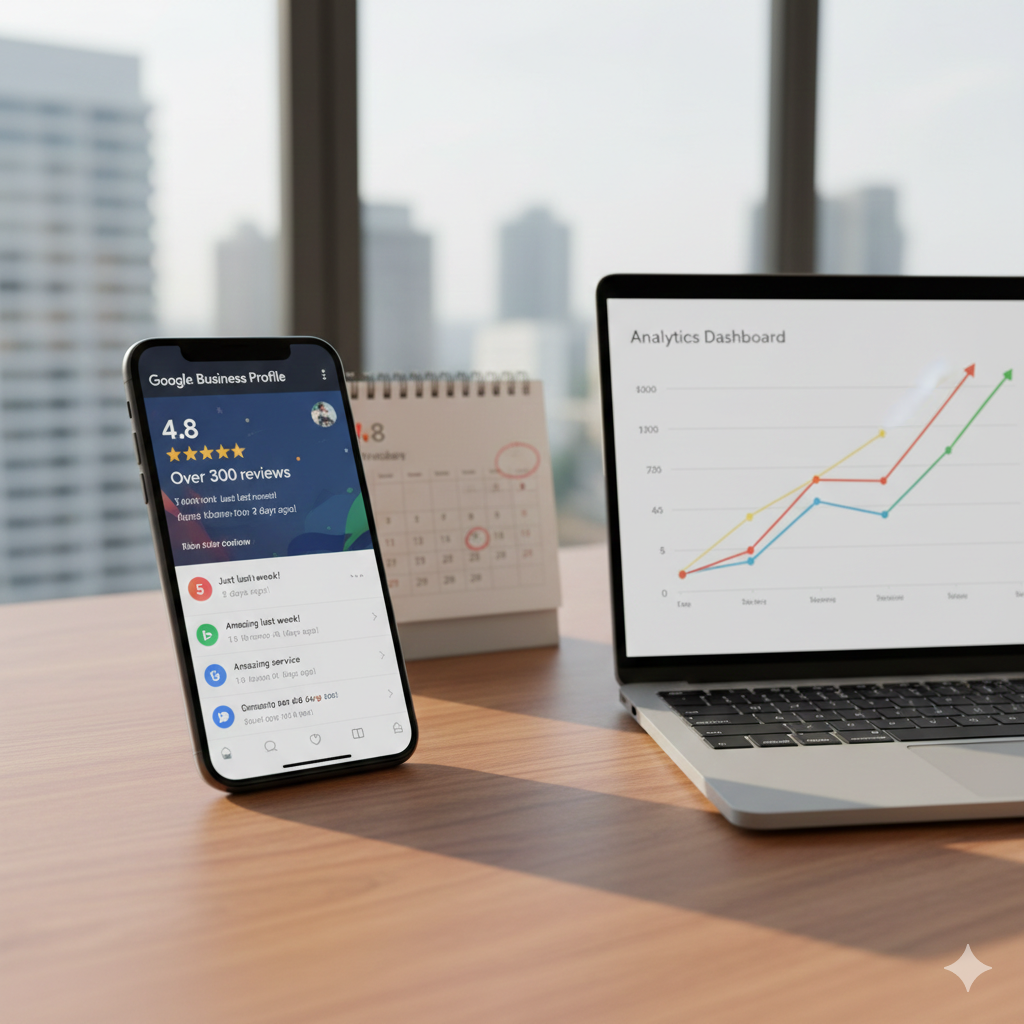
165 reviews, 4.8 rating, 100% response rate
Conversion rate: 43%
Customers per month: 21.5
Monthly revenue: $18,275
Annual revenue: $219,300
Annual revenue difference: $127,500
Same leads. Same service quality. Same pricing. The ONLY difference is the trust infrastructure operating before prospects make contact decisions.
But it compounds:
With 2.4x more revenue, Business B:
Invests more in marketing (generating more leads)
Hires better talent (improving service further)
Upgrades systems and equipment (widening quality gap)
Within 18-24 months, the gap becomes a chasm that's nearly impossible to close.
The 5 Components of the Silent Advantage
Component 1: The Trust Volume Threshold
The Psychology:
100 reviews is the psychological threshold where prospects stop evaluating whether to trust you and start assuming they should.
Below 100: "Is this business legitimate and reliable?" Above 100: "This is an established, proven business."
Why Most Businesses Never Reach It:
Manual review requests generate 3-8% conversion rate. At 50 monthly customers, that's 1.5-4 reviews per month. To reach 100 reviews takes 25-66 months.
Most businesses give up long before crossing the threshold. They plateau at 30-60 reviews and assume "that's just how many reviews businesses get."
Your Competitor's Advantage:
They deployed a system designed to automatically get more reviews at 18-25% conversion rates.
At 50 monthly customers, that's 9-12.5 reviews monthly. They crossed the 100-review threshold in 8-11 months and never looked back.
The silent advantage isn't their service—it's their systematic approach to converting service quality into visible trust signals.
The Compounding Effect:
Once past 100 reviews:
Higher local search ranking (more organic leads)
Better conversion rate (more customers from existing leads)
Stronger pricing power (higher revenue per customer)
More resources for marketing (even more leads)
The 100-review threshold is where linear growth becomes exponential.
Component 2: The Engagement Authority Signal
What Prospects Actually See:
When evaluating businesses, prospects scroll through Google reviews looking for patterns. They're not just reading content—they're evaluating whether the business is actively managed.
Your Profile:
42 reviews, 12 have responses (29%)
Responses are inconsistent (some detailed, some generic)
Latest response: 18 days ago
Several negative reviews unaddressed
Competitor's Profile:
165 reviews, 165 have responses (100%)
Responses are consistently professional and personalized
Latest response: 6 hours ago
All negative reviews addressed within 24 hours
The Unconscious Calculation:
"This business responds to everyone, consistently, professionally, immediately. They're actively engaged with customers. That means competent management. That means my job won't fall through the cracks."
Businesses that consistentlyrespond to reviewssend a powerful signal that nothing slips through the cracks.
The Manual Response Trap:
Responding to reviews manually requires:
Remembering to check multiple platforms daily
Writing thoughtful responses when busy
Maintaining consistency during high-stress periods
Result: 30-60% response rates that signal inconsistent management.
Automated reputation management platforms aggregate all reviews into one dashboard with instant alerts, making 100% response rate achievable in 5-10 minutes daily.
Component 3: The Velocity Momentum Signal
The Recency Trust Factor:
Prospects unconsciously evaluate review dates to assess current quality.
Your Review Pattern:
Most recent: 12 days ago
Before that: 6 days
Before that: 19 days
Before that: 31 days
Average gap: 17 days
Competitor's Review Pattern:
Most recent: 2 days ago
Before that: 4 days
Before that: 3 days
Before that: 5 days
Average gap: 3.5 days
What This Signals:
Your pattern: "Inconsistent business activity. Possibly seasonal slowdown. Maybe quality is declining."
Their pattern: "Consistent high customer volume. Currently active and busy. Quality is maintained."
The silent advantage of consistent velocity is that prospects never question whether you're currently serving customers successfully the evidence is constantly refreshed.
Maintaining Velocity:
Requires automated systems that:
Request reviews from 100% of customers (not just when you remember)
Trigger requests at optimal timing (24-48 hours post-service)
Use multi-channel sequences (SMS → Email → Phone for high-value customers)
Alert you during review gaps for past-customer reactivation
Component 4: The Social Proof Placement Strategy
Where Trust Gets Built:
Your competitor isn't just collecting reviews they're strategically showcasing them at every decision point in the customer journey.
Their Website:
Homepage hero: "Rated 4.8/5 by 165+ customers" above the fold
Service pages: Relevant reviews addressing page-specific objections
About page: Team credibility supported by customer testimonials
Contact page: "Join our 165 satisfied customers" social proof
Prospects encounter your competitor's trust signals 5-8 times before making a decision. Each exposure builds unconscious confidence. By the time they're ready to buy, trust isn't a question it's an assumption.
You're building trust signals but not showcasing them. They're weaponizing every trust signal they generate.
Component 5: The Automated Prevention System
The Critical Difference:
Your competitor generates 15 reviews per month with a 4.8 average rating. You generate 3 reviews per month with a 4.4 average rating.
The difference isn't service quality it's the two-stage feedback routing system that prevents negative reviews from going public while maximizing positive ones.
How Two-Stage Routing Works:
Stage 1: Private Feedback Collection
All customers receive an initial feedback request with a simple 1-5 star rating:
If 4-5 stars: Automatically redirect to Google/Facebook with message: "Thank you! Would you share your experience publicly?"
If 1-3 stars: Route to private feedback form: "We're sorry we didn't meet expectations. Please tell us what happened so we can make it right."
Stage 2: Rapid Issue Resolution
For negative private feedback:
Manager alerted within 15 minutes
Customer contacted within 4 hours
Issue resolved completely
Follow-up 48-72 hours later: "We're glad we could fix this. Would you consider sharing how we handled it?"
The Results:
60-70% reduction in negative public reviews
30-40% of resolved issues convert to positive public reviews
Higher average rating despite identical service quality
Stronger trust signals from same customer base
Why This Is a Silent Advantage:
Prospects comparing you see:
Your profile: Mix of positive and negative reviews, 4.4 average
Competitor profile: Mostly positive reviews with few negatives (all well-handled), 4.8 average
They unconsciously assume the competitor delivers better service. Reality: identical service quality, different reputation infrastructure.
The 90-Day Silent Advantage Build Plan
Launch systems that automatically help you get more reviews from 100% of new customers
Here's how to build what your competitor has (or close the gap if they're ahead):
Month 1: Foundation
Week 1: Infrastructure Setup
Deploy automated review request system integrated with CRM
Implement two-stage feedback routing
Set up centralized review monitoring dashboard
Establish 100% response protocol
Week 2: Volume Acceleration
Launch automated requests to 100% of new customers
Establish a protocol to respond to reviews within 24 hours across every platform.
Focus Areas:
Maintain velocity momentum (track weekly, never >10 day gaps)
Refine review content quality through strategic prompting
Expand social proof placement (vehicles, yard signs, business cards)
Test initial pricing increase (5-8% if conversion maintained)
Advanced Tactics:
Past customer reactivation (6-18 month satisfied customers)
High-value customer phone follow-ups for detailed reviews
Team training on natural review conversation triggers
Competitor velocity monitoring
Expected Month 2 Results:
Review count progress toward 100-review threshold
Conversion rate improvement: 18-28%
Initial pricing power emerging
Month 3: Optimization
Focus Areas:
Push toward or past 100-review threshold
Analyze review content for objection coverage gaps
Implement advanced negative review prevention
Lock in new baseline conversion rate
Advanced Tactics:
Review content engineering for specific buyer objections
Multi-platform expansion (once Google is strong)
Referral program leveraging social proof
Case study development from detailed reviews
Expected Month 3 Results:
Meaningful competitive progress visible
Conversion rate: 25-40% improvement vs. baseline
Pricing power: 10-18% premium sustainable
Sales cycle: Measurably shorter
Month 4+ Results:
Silent advantage fully operational
Compounding effects begin (better conversion → more revenue → more investment → stronger advantage)
Competitive gap widens instead of narrowing
Why Most Businesses Never Build This
Understanding why the silent advantage is rare helps you commit to building it:
Reason 1: It's Invisible to You
You experience your service quality directly. You don't experience your prospect's psychological evaluation of trust signals. Most business owners assume service quality matters most because that's what they control and measure.
Reason 2: Manual Systems Don't Scale
Business owners try manual review requests for a few months, get inconsistent results (3-8% response rate), and conclude "customers just don't leave reviews." They never reach the volume where the advantage activates.
Reason 3: Delayed Gratification
The silent advantage takes 90-180 days to fully materialize. Most business owners expect immediate results, don't see them, and abandon the effort before crossing the psychological thresholds that matter.
Reason 4: Competitor Blindness
You don't watch your competitor's review profile grow week by week. You see a snapshot: "They have 165 reviews, I have 42." You don't realize they were at 42 reviews 18 months ago and built systematically to 165.
Reason 5: The Service Quality Trap
"I'll focus on getting better at my craft, and reviews will follow naturally." This sounds logical but ignores that the 5-10% of businesses with silent advantages have BOTH great service AND systematic trust infrastructure.
180 days: You cross competitive trust thresholds, pricing power emerges
12 months: You've taken market share from competitors who are still wondering why their leads stopped converting
24 months: Your silent advantage is a competitive moat that's nearly impossible to overcome
Scenario 2: You Don't Build It
90 days: Competitor continues pulling ahead in conversion and pricing
180 days: Revenue gap widens, they invest more in marketing and talent
12 months: They're the established market leader; you're the "other option"
24 months: They've built a psychological moat so deep that matching their service quality doesn't matter—you're operating at a permanent trust deficit
The Choice:
This isn't about working harder. It's about building infrastructure that makes your work visible and your quality believable before prospects evaluate you.
Stop Letting Your Competitor's Silent Advantage Steal Your Revenue
You're delivering excellent service. You're answering calls. You're showing up on time. You're solving problems.
And your competitor with mediocre service is making 2-3x more revenue from the same number of leads.
The difference isn't what you're doing. It's what's working for them before prospects ever contact either of you.
Review Crusher AI helps local businesses build the exact silent advantage your competitor has or take yours even further.
Our reputation management platform automates review requests at optimal timing, routes unhappy customers to private resolution before they go public, ensures 100% response rate through centralized monitoring, and gives you the analytics to track conversion improvements directly correlated to trust signal strength.
Stop working harder for less. Start building the infrastructure that makes prospects choose you before they evaluate anyone else.
Ready to build your silent advantage?
Get started for free and see how automated reputation management converts your service quality into the trust signals that close 25-40% more deals. Our clients don't just get more reviews they get the systematic competitive advantage that becomes progressively harder for competitors to overcome.
Your service quality deserves to win. Build the silent advantage that makes it inevitable.
The Silent Advantage System
The silent advantage is systematic trust infrastructure that converts prospects before first contact. It’s built on five core components: a trust volume threshold (100+ reviews signal established authority), engagement authority signals (100% response rate proves competent management), velocity momentum (consistent new reviews signal current quality), strategic social proof placement across every touchpoint, and automated prevention systems that protect ratings while maximizing review volume.
Building this system requires automated reputation management platforms that drive 18–25% review conversion rates (compared to 3–8% manually), maintain 100% response rates through centralized monitoring, prevent negative public reviews through structured feedback routing, and position trust signals strategically throughout the customer journey.
Implementation follows a clear three-month roadmap: Month 1 focuses on foundation and velocity acceleration, Month 2 on optimization and expansion, and Month 3 on threshold crossing and competitive displacement. Expected outcomes include a 25–40% improvement in conversion rates, a 10–18% pricing premium, shorter sales cycles, and compounding competitive advantages over time.
How long before the silent advantage starts working?
Initial conversion improvements appear within 30-45 days as review velocity increases and response rate reaches 100%. Meaningful competitive advantage emerges at 60-90 days. Full psychological thresholds (100+ reviews, sustained engagement) typically activate at 90-180 days depending on customer volume.
My competitor has 300 reviews. Can I catch up?
Focus on velocity, not total count. Generating 15+ reviews monthly with 100% response rate creates momentum and engagement signals that overcome total count disadvantages within 12-18 months. Meanwhile, your consistent activity is immediately visible to prospects comparing you.
What's the ROI of building this infrastructure?
For a business with 50 monthly leads at $850 average value: improving conversion from 18% to 35% generates $7,225 additional monthly revenue ($86,700 annually). Most businesses invest $200-500/month in reputation systems, delivering 15-30x ROI.
Can I build this manually without software?
Theoretically yes, practically no. Manual systems work for 15-20 customers monthly. Beyond that, consistency collapses (you forget, you're busy, timing gets missed). Automated systems handle 500 customers with the same efficiency as 50.
What if I don't have many customers yet?
Start building the infrastructure now with whatever volume you have. Even at 10-15 customers monthly, automated systems generate meaningful review velocity. By the time your customer volume increases, your trust infrastructure is already established—giving you conversion advantages as you scale.
Protect Your Reputation
Stop juggling reviews across different platforms. Centralize everything with ReviewCrusher’s review management software and start getting more reviews in less time.