How to Build a 5-Star Brand That Sells Itself : A Practical Guide
Rick Bengson
Founder, CEO
February 16, 2026
Reputation That Converts More Customers
TL-DR A 5-star brand that sells itself is built on systematic trust signals, not luck or perfection. Businesses with 100+ recent reviews close deals at 3-4x higher rates than competitors with sparse feedback, command 15-25% pricing premiums, and reduce customer acquisition costs by 40-60%. This system requires three pillars: high-volume review generation (3-5% of customers monthly), strategic review positioning that addresses buyer objections, and automated reputation maintenance that works 24/7. When executed correctly, your online presence becomes your best salesperson—converting prospects before they even contact you.
"A strong reputation doesn't just attract customers—it closes them before the first conversation."
You spend $3,000 a month on ads. You close maybe 15% of calls. Your sales team burns hours answering the same objections: "Are you reliable?" "Why should I trust you?" "What makes you different from the other three quotes I got?"
Meanwhile, your competitor down the street with worse service than yours closes 40% of their calls, charges 20% more, and barely advertises. What's the difference?
They built a 5-star brand that sells itself before prospects ever pick up the phone.
Here's what most local business owners miss: a 5-star brand isn't about being perfect it's about being systematically trusted. When your online presence demonstrates consistent excellence through dozens or hundreds of customer reviews, you stop selling and start qualifying. Prospects call already convinced. Objections disappear. Price sensitivity drops. Your conversion rate doubles or triples without changing anything about your actual service delivery.
This guide shows you exactly how to build a review-driven brand that does your selling for you. You'll learn the reputation architecture that converts skeptics into believers before the first conversation, the automation systems that generate trust signals at scale, and the positioning strategies that let you charge premium prices while competitors race to the bottom.
The Trust Problem Killing Your Conversion Rate
Let's diagnose why your business isn't selling itself:
The Cold Start Dilemma
Every prospect interaction starts from zero trust. They don't know you. They don't know if you're competent, honest, or reliable. They're comparing you against 4-6 competitors, and without differentiation, they default to price.
Your sales pitch tries to build trust in 15 minutes. Your competitor's 5-star brand builds trust in 15 seconds.
The Revenue Math of Low Trust
Track what happens when prospects can't quickly validate your credibility:
Longer sales cycles: 3-5 touchpoints instead of 1-2 (more labor cost, lower close rate)
Higher price sensitivity: 40-50% of conversations focus on cost when trust is low
Lower deal sizes: Prospects minimize risk by starting with smaller projects
More cancellations: Low-trust buyers have higher buyer's remorse and cancellation rates
One local HVAC company calculated this cost: $127,000 annually in lost margin from price-based competition and delayed closes. Their service quality didn't change they just couldn't prove it fast enough.
The Competitor Advantage
Your competitor with 200+ Google reviews and a 4.8-star average isn't just "more popular." They've built a trust-generating machine that works while they sleep.
When prospects Google "[your service] near me," they see:
Your listing: 23 reviews, most recent 4 months ago, 4.4 stars
Competitor listing: 187 reviews, 12 posted this week, 4.8 stars
Who gets the call? Who gets the benefit of the doubt on pricing? Who closes faster?
The business with the 5-star brand doesn't work harder they built systems that make trust automatic.
The Strategic Framework: Three Pillars of a Self-Selling Brand
Here's how elite local businesses architect brands that convert before contact:
Pillar 1: Trust Density (Review Volume × Recency)
The Trust Density Formula:
Trust Density = (Total Reviews × Review Recency Score) / Time in Business
A business with 150 reviews where 60 came in the last 90 days has higher trust density than a business with 300 reviews where the most recent is 6 months old.
Why This Matters:
High trust density signals three things to prospects:
Social proof: Many people have successfully used this business
Current relevance: The business is actively serving customers right now
Consistency: Quality hasn't degraded over time
When trust density is low, prospects hesitate. When it's high, they commit.
The Competitive Benchmark:
Calculate your trust density target:
Identify your top 3 local competitors
Count their reviews in the last 90 days
Set your target at 120% of their average
If competitors average 15 reviews per month, you need to generate 18-20 monthly to create competitive advantage.
Not all reviews create equal trust. A 5-star brand uses reviews to address the specific objections prospects have BEFORE they ask.
The Buyer Objection Map
Every industry has 3-5 primary objections that kill deals:
Home Services (Plumbing, HVAC, Electrical):
"Will they show up on time?"
"Will they find 'extra problems' to upsell me?"
"Do they clean up after themselves?"
"Are the technicians actually trained?"
Professional Services (Legal, Accounting, Consulting):
"Will they actually understand my specific situation?"
"Are they responsive to questions?"
"Will they explain things in plain language?"
"Is their pricing transparent?"
Restaurants/Hospitality:
"Is the food actually fresh?"
"How long are the wait times?"
"Do they accommodate dietary restrictions?"
"Is the service friendly or rushed?"
The Strategic Review Collection Approach
Instead of generic "Please leave us a review," guide satisfied customers toward addressing these objections:
For home services competing on reliability:
"If our team arrived on time and respected your home, we'd really appreciate you mentioning that in a Google review it helps other homeowners know what to expect."
For professional services competing on expertise:
"If you felt we took time to understand your unique situation and explained everything clearly, a quick review about your experience would help others who need [service type]."
For restaurants competing on quality:
"If you enjoyed the freshness of your meal and our accommodating service, we'd love a review mentioning what you ordered it helps diners know what to try!"
Notice the pattern? You're prompting (not scripting) customers to address the exact concerns your next prospect has.
Pillar 3: Automated Reputation Maintenance
Manual review management collapses under scale. A 5-star brand runs on automation that maintains trust without daily effort.
Gap: You need to generate 12 additional reviews monthly just to maintain position, and 17+ monthly to gain ground.
Implementation:
Send automated request 24-48 hours after service completion
Use SMS for immediate engagement: "Quick question: How would you rate your experience with [Business] today? 1-5 stars [Link]"
Route based on response:
If 4-5 stars → Automatic redirect to Google/Facebook with message: "Thank you! Would you mind sharing your experience publicly? It really helps other [customers] find us."
If 1-3 stars → Route to private feedback form: "We're sorry we didn't meet expectations. Please share what went wrong so we can make it right: [Form Link]"
Stage 2: Rapid Issue Resolution
For low ratings:
Alert relevant team member within 15 minutes
Initiate contact within 4 hours
Resolve issue completely
Follow up 48 hours later: "We're glad we could resolve this. Would you consider updating your feedback based on how we handled the situation?"
Email: Personalized message with social proof (recent review examples)
Expected response: 8-12%
Day 7 (High-Value Customers Only):
Personal phone call or handwritten note
Expected response: 35-45%
Optimization Tips:
Personalization matters: "Thanks for trusting us with your kitchen remodel, Sarah" outperforms "Thanks for your business" by 3x
Mobile optimization critical: 82% open on mobile ensure one-click review submission
Timing precision: Requests sent within 24 hours get 2-3x response vs. 7+ day delays
Step 4: Optimize for Review Content Quality
The Review Prompt Framework:
Every review request should subtly guide toward objection-addressing content:
Generic (Weak):"Please leave us a review!"
Strategic (Strong):
"If you appreciated [specific service element that addresses objection], we'd love if you mentioned it in a Google review—it helps other [customer type] understand what to expect."
Examples:
HVAC company (objection: reliability):
"If our technician arrived on time and explained everything clearly, mentioning that in a review really helps other homeowners know we respect their schedule."
Attorney (objection: communication):
"If you felt we kept you informed throughout the process and answered your questions promptly, sharing that experience helps others who are navigating [legal issue]."
Restaurant (objection: food quality):
"If you loved the [specific dish] and appreciated our attention to your dietary needs, we'd be grateful if you mentioned it—helps other diners know what to try!"
Step 5: Master Review Response Strategy
100% Response Rate Non-Negotiable
Every review positive or negative gets a response within 24 hours. Why?
The reviewer feels valued (increases loyalty and referral likelihood)
Future prospects read responses more carefully than reviews
Google's algorithm rewards engagement (local SEO boost)
Response Framework for Positive Reviews:
Personalize: Reference specific detail from their review
Appreciate: Thank them genuinely
Reinforce: Mention the team member or specific action
Invite: Encourage return visit or referral
Example:
Review: "Best HVAC company we've used! John explained everything about our new system and was super professional."
Response: "Thank you so much, Sarah! We're thrilled John could help you understand your new system he takes real pride in making sure customers feel informed and comfortable. We appreciate your trust and look forward to being your HVAC partner for years to come!"
Response Framework for Negative Reviews:
(See detailed framework in the Managing Negative Reviews section this deserves its own complete system)
Quick structure:
Acknowledge specific issue
Take responsibility
Explain corrective action
Offer private resolution
Demonstrate company values
Step 6: Integrate Reviews Into Every Customer Touchpoint
Your 5-star brand should be visible at every stage of the customer journey:
Awareness Stage:
Reviews appear in local search results (Google Business Profile optimization)
Review count and rating in paid ad copy
Review widgets on homepage above the fold
Consideration Stage:
Service-specific review highlights on landing pages
Video testimonials from top reviewers
Case studies expanded from detailed reviews
Decision Stage:
Review-based FAQ sections that address objections
Sales team references specific reviews during consultations
Proposal templates include relevant customer testimonials
Retention Stage:
Thank you emails reference how reviews help the business
Service reminders include recent review highlights
Loyalty programs reward review contributions
Example Integration:
Homepage Hero Section:
"Trusted by 300+ [City] Homeowners"★★★★★ 4.8/5.0 from 287 Google Reviews[See What Customers Say] CTA
Service Page:
"Don't just take our word for it here's what happens when [Customer Type] chooses [Business]:"[3-4 specific reviews addressing that service's key objections]
Email Signature:
★★★★★ Rated 4.8/5 by 287+ Customers [Read Reviews]
Step 7: Track Trust Metrics That Matter
Leading Indicators (What Creates the Brand):
Review request send rate (% of customers asked)
Review completion rate (% who follow through)
Average rating of new reviews
Review velocity (reviews per 30 days)
Response rate to reviews
Time to respond (average hours)
Lagging Indicators (Brand Impact on Business):
Conversion rate by review count segment
Average deal size: review-aware vs. unaware customers
Sales cycle length: before vs. after review system
Customer acquisition cost reduction
Price premium captured vs. competitors
Referral rate improvement
Target Benchmarks:
Review completion rate: 15-25%
Review velocity: 3-5% of monthly customers
Response rate: 100% within 24 hours
Conversion rate lift: 30-50% vs. pre-system baseline
CAC reduction: 40-60% as brand strengthens
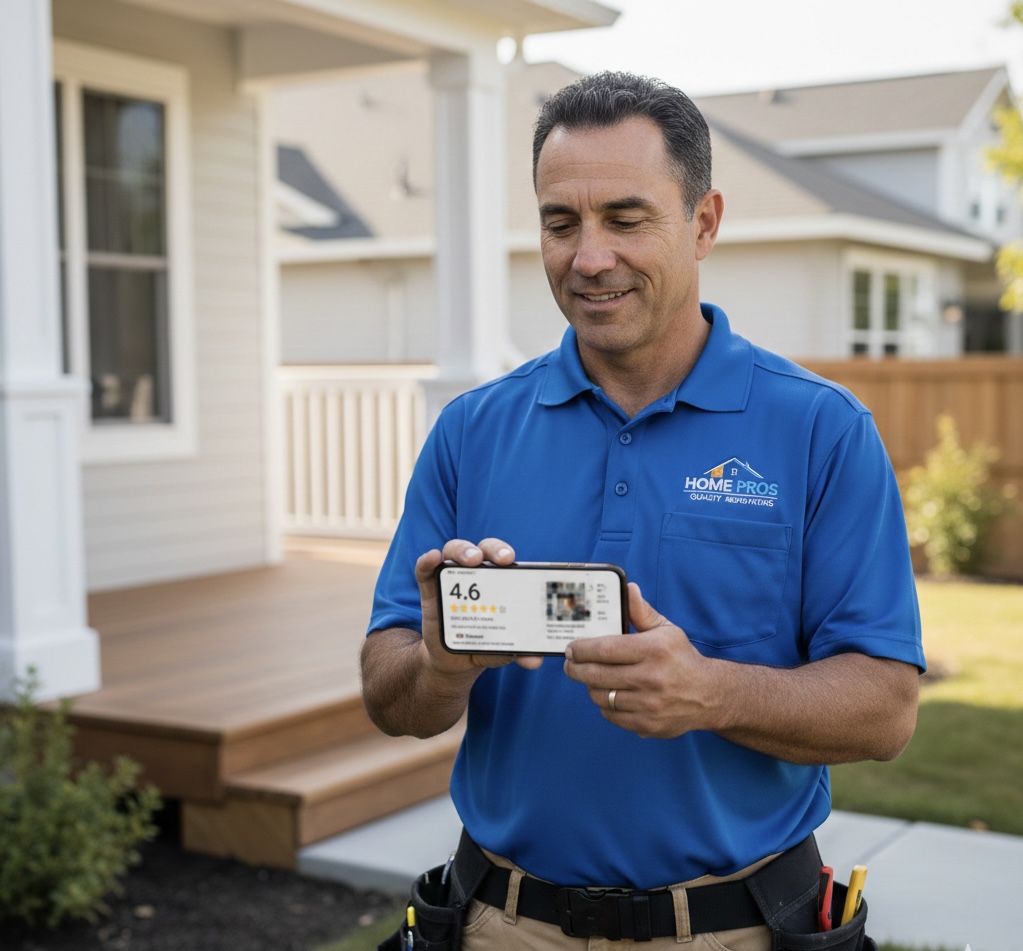
Local business owner displaying 5-star Google reviews
Advanced Strategy: The Review-Driven Pricing Premium
Here's counterintuitive growth: a strong 5-star brand lets you charge 15-25% more than competitors while maintaining or improving close rate.
Why Premium Pricing Works with Strong Reviews:
Trust reduces price sensitivity: Prospects pay for certainty, not discount pricing
Reviews justify value: Social proof pre-frames your pricing as fair
Positioning shifts: You're the quality choice, not the commodity option
The Strategic Pricing Escalation Path:
Phase 1 (0-50 reviews): Price at market rate
Focus: Build review volume and rating
Goal: Establish baseline trust
Phase 2 (51-100 reviews): Test 8-12% price increase
Focus: Review content quality and objection-addressing
Goal: Validate pricing power
Phase 3 (100+ reviews with 4.7+ rating): Implement 15-25% premium
Focus: Review velocity maintenance and competitor gap
Goal: Premium positioning with trust-justified pricing
Real Example:
Local plumbing company with comprehensive reputation management platform:
Before (32 reviews, 4.2 rating): $95/hour service call, 18% close rate
After (147 reviews, 4.8 rating): $125/hour service call, 41% close rate
Result: 31% higher pricing + 2.3x better close rate = 200%+ revenue per lead
The reviews didn't just increase trust they fundamentally changed the economics of the business.
TL-DR: The 5-Star Brand System
Building a brand that sells itself requires three systematic pillars:
High-volume review generation: Convert 3-5% of monthly customers into reviews using automated multi-channel sequences
Strategic review positioning: Guide reviews to address specific buyer objections that kill deals
You don't need flawless service to build a 5-star brand. You need consistent, good service + systematic review collection + excellent issue resolution.
A 4.7-4.8 rating with 150+ reviews beats a 5.0 rating with 12 reviews every time. Volume + consistency > perfection.
Mistake 2: Generic Review Requests
"Please leave us a review" generates 3-5% response.
Personalized, specific requests generate 15-25% response.
The difference: "Thanks for your business" vs. "Thanks for trusting us with your daughter's college planning, Jennifer—if our process felt thorough and personalized, we'd love if you shared your experience."
Mistake 3: Ignoring Negative Reviews
Unresponded negative reviews damage trust 3x more than the review itself.
Well-handled negative reviews can increase trust MORE than generic positive reviews—they prove you care about customer experience and fix problems.
Mistake 4: Manual-Only Systems
You can't manually:
Remember to request reviews from every customer
Respond to reviews across platforms within 24 hours
Route unhappy customers before they go nuclear
Track performance metrics accurately
Manual systems collapse under growth. Automation scales infinitely.
Mistake 5: Platform Diversification Too Early
Focus 100% effort on Google Business Profile until you have 100+ reviews and 4.7+ rating.
Google drives 70-80% of local search traffic. Master one platform before diversifying to Facebook, Yelp, industry-specific sites.
Mistake 6: No Review Showcasing
Collecting reviews but not displaying them prominently on your website, proposals, and marketing materials is leaving money on the table.
Your 5-star brand should be visible everywhere prospects look.
Revenue Impact: +$470,000 annual revenue with same capacity
The practice didn't improve clinical quality they systematized trust generation.
Building Your 5-Star Brand: 90-Day Implementation Plan
Days 1-30: Foundation
Complete trust audit and competitive analysis
Implement two-stage feedback routing system
Set up automated review request sequences
Train team on review conversation triggers
Establish 100% review response protocol
Days 31-60: Volume Generation
Launch review request automation to 100% of customers
Optimize request messaging based on response data
Add review widgets to website and marketing materials
Create review-based content for social media
Track and optimize conversion metrics
Days 61-90: Strategic Positioning
Refine review prompts to address specific objections
Expand review showcase across all customer touchpoints
Test pricing premium (8-12% increase)
Implement review-based sales enablement
Measure brand impact on conversion and deal size
Month 4+: Optimization and Scale
Continuously improve request messaging
Expand platform presence (Facebook, industry sites)
Create video testimonial program from top reviewers
Build referral program around 5-star brand
Track long-term trust metrics and revenue correlation
Step 2: Build the Two-Stage Feedback Funnel
This is the critical system that prevents negative reviews while maximizing positive ones.
Stage 1: Internal Feedback Collection
Create a private feedback page customers hit first before being directed to public platforms. Use a simple 1-5 star rating:
Turn Your Reputation Into Your Competitive Advantage
Most local businesses hope for good reviews. Elite businesses engineer them systematically.
The difference isn't better service it's having an automated review generation platform that builds trust at scale while you focus on operations.
Review Crusher AI helps local businesses build exactly this system.
Our platform automates review requests at optimal timing, routes unhappy customers to private feedback channels before they damage your reputation, ensures 100% review response across all platforms, and provides the analytics that prove ROI.
Stop competing on price because you can't prove value. Start building a 5-star brand that sells itself.
Ready to build a reputation that drives revenue?
Get started for free and see how automated reputation management converts your customer base into your most effective sales team. Our clients generate 3-5x more reviews than competitors while increasing conversion rates by 30-50% and capturing 15-25% pricing premiums because they've systematized what everyone else is leaving to chance.
Your reputation is your revenue engine. Build it like one.
FAQ
Below are concise answers to the most common questions managers ask when they confront reviews affecting a luxury brand.
How long does it take to build a 5-star brand?
Meaningful trust signals appear in 60-90 days with systematic implementation. Competitive advantage develops at 100+ reviews with 4.7+ rating, typically achievable in 6-12 months depending on customer volume and review conversion rate.
What if my service quality isn't perfect yet?
You don't need perfection you need consistent good service + excellent issue resolution. A 4.7-4.8 rating with high volume beats 5.0 with low volume. Focus on preventing negative reviews through feedback routing and resolving issues before they go public.
How many reviews do I need to justify premium pricing?
Pricing power emerges around 75-100 reviews with 4.7+ rating. Test 8-12% increases at 50+ reviews. Full premium positioning (15-25% above market) becomes sustainable at 100+ reviews with consistent velocity.
Can I build this manually or do I need automation?
Manual works for 20-30 customers monthly. Beyond that, automation is required for consistency, speed, and scale. Manual systems collapse during busy periods exactly when you need reputation maintenance most.
What if competitors have huge review leads?
Focus on review velocity, not total count. Outpacing competitors by 20-30% monthly reviews creates momentum. A business with 60 reviews but 15/month velocity outranks a business with 200 reviews but 2/month velocity within 12-18 months.
How do I prevent fake review accusations?
Systematic review requests to real customers with automated review request systems are completely legitimate. Never incentivize positive reviews or pay for reviews. Request feedback from every customer equally and let organic results drive ratings. Authenticity is defensible; manipulation isn't
Protect Your Reputation
Stop juggling reviews across different platforms. Centralize everything with ReviewCrusher’s review management software and start getting more reviews in less time.